
At the 2025 NFWI Annual Meeting, members voted for the Bystanders Can Be Lifesavers resolution. The resolution is as follows:
Bystanders can be lifesavers
There are over 30,000 out-of-hospital cardiac arrests a year in the UK, and less than one in ten people survive. Women have a lower chance of surviving than men. Early cardiopulmonary resuscitation (CPR) and defibrillating can more than double the chances of survival. We call on WI members to work together to increase public confidence and training in the delivery of CPR and to work with local organisations to help improve access to defibrillators in their communities to give every person the best chance of surviving a cardiac arrest.

Background
A cardiac arrest is caused by an electrical problem in the heart. A person undergoing a cardiac arrest will be unconscious and not breathing. Cardiac arrest can be caused by defects to the heart, such as coronary heart disease or a heart attack, or external factors such as drug overdose, drowning, or choking.
According to the British Heart Foundation, more than 30,000 people have an out-of-hospital cardiac arrest in the UK each year, and the overall survival rate of people suffering from cardiac arrest out of hospital is less than 1 in 10, lower than in comparable countries across the world. Every minute without cardiopulmonary resuscitation (CPR) and defibrillation reduces the chance of survival by up to 10%. People who are trained in CPR will buy time for the casualty until professional help arrives.
There is evidence to show that the bystander response can have a huge impact. The Resuscitation Council states that the chance of survival can increase two or threefold when bystander CPR is used. A defibrillator can also make a critical difference, as when used within the first three minutes, it can increase the chances of someone surviving a cardiac arrest by up to 70%.
St John Ambulance’s research suggests appropriate training could address the problem, with 64% of all respondents indicating that they would feel more comfortable performing CPR if they received the right education and support.
In February 2024, new figures published by BHF found that nearly half of UK adults (43%) have never learned CPR. Cardiac arrest recognition remains a key priority as it is the first step in triggering the emergency response to cardiac arrest. Creating a CPR-trained society will save more lives, improve public health, and enhance community resilience during emergencies.
As well as delivering CPR, a defibrillator device can be used on someone experiencing cardiac arrest, which issues a high-energy shock to the heart and helps to restore a regular heart rhythm. Defibrillators are unevenly distributed across the UK; many are kept behind locked doors in private facilities. It is critical to know where your nearest and accessible defibrillator is to ensure someone experiencing a cardiac arrest can be supported as quickly as possible.
The Circuit is the national defibrillator network which provides the NHS ambulance services with vital information about defibrillators across the UK so that they can be accessed quickly to help save lives. Members can check whether their local defibrillators are registered with the circuit, and register defibrillators themselves, in a few easy steps on The Circuit website.
Why is Cardiac Arrest a Feminist Issue?
Fear: Research has found that 1/3 of the British public are scared to give CPR to a woman. Research by St John Ambulance has estimated that more than 8,200 women in England and Wales could have survived a heart attack if they had been given the same treatment as men, according to an analysis of data from between 2003 and 2013. The survey also found that 38% of Britons say they would feel uncomfortable using a defibrillator on a woman, as its pads need to be placed on bare skin in the chest area.
Lack of recognition: It is a common myth that women suffer from unusual or ‘atypical’ heart attack symptoms, when in reality, both sexes have very similar symptoms and warning signs of cardiac arrest. Some data suggests that women are less likely to be recognised by bystanders as experiencing cardiac arrest (Perman et al., 2019), including being less likely to receive in-hospital interventions (Lei et al., 2020).
Training: 95% of CPR training manikins on the global market are flat-chested, and are used in training demonstrations with no bra being worn (St John Ambulance). Ensuring CPR training manikins are representative of diverse bodies bystanders may encounter will assist in improving bystander CPR delivery and cardiac arrest survival outcomes for all.
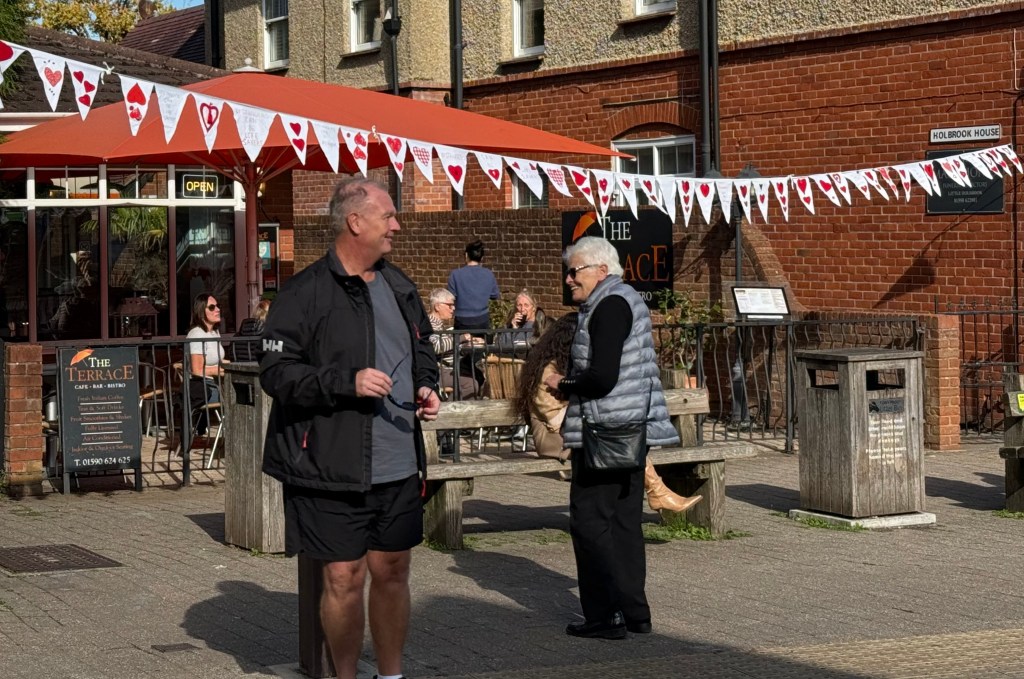
Today, 16th October is World Restart a Heart Day. So Brockenhurst WI took our campaign and our bunting made by our Craft Group out into Brockenhurst Village and gave out information cards letting people know where they can find the nearest defibrillator (wherever they are in the country). The defibrillator locator website can be found here.
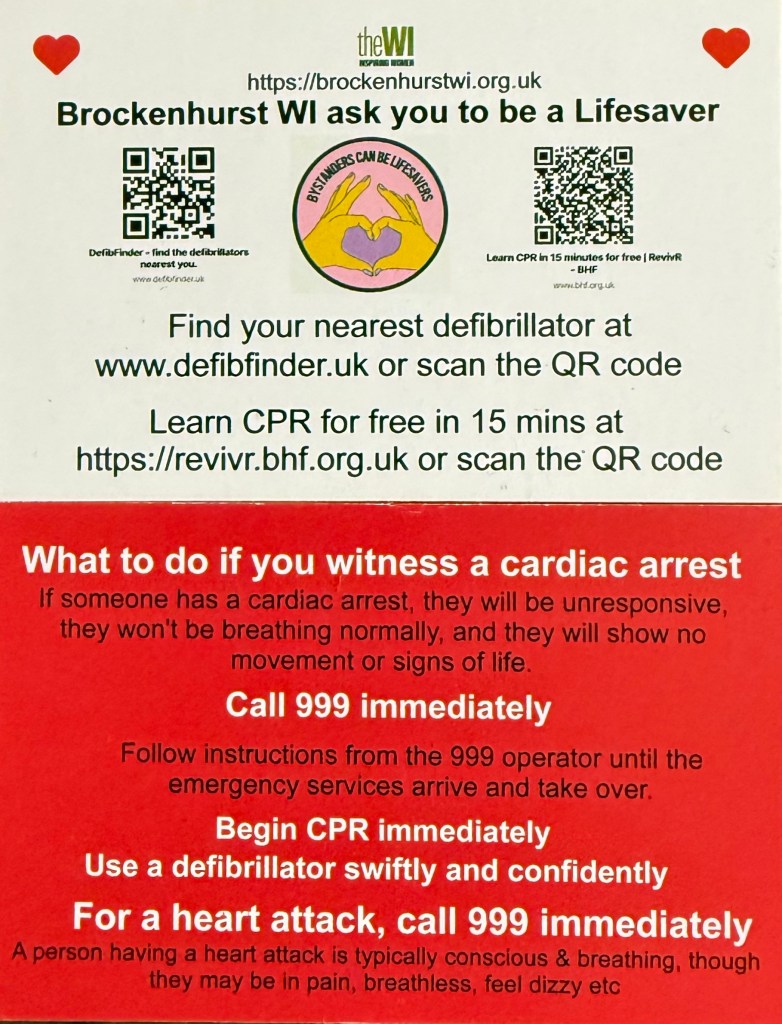
The card also has a link to BHF’s RevivR CPR and defibrillator training which is a great resource that just takes 15 minutes. You just need a phone or tablet and a cushion! Learn CPR here.
Thank you to all the people who took cards and talked to us today.
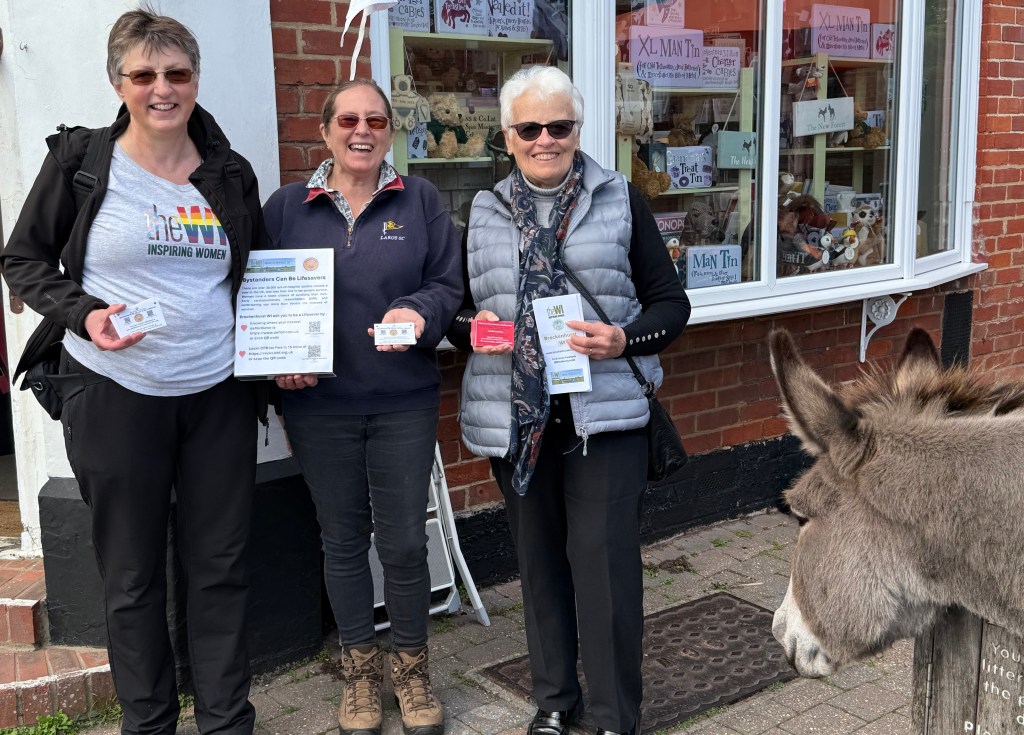
We especially enjoyed the enthusiasm and thanks we got from Brockenhurst College students .
 Brockenhurst Women's Institute