
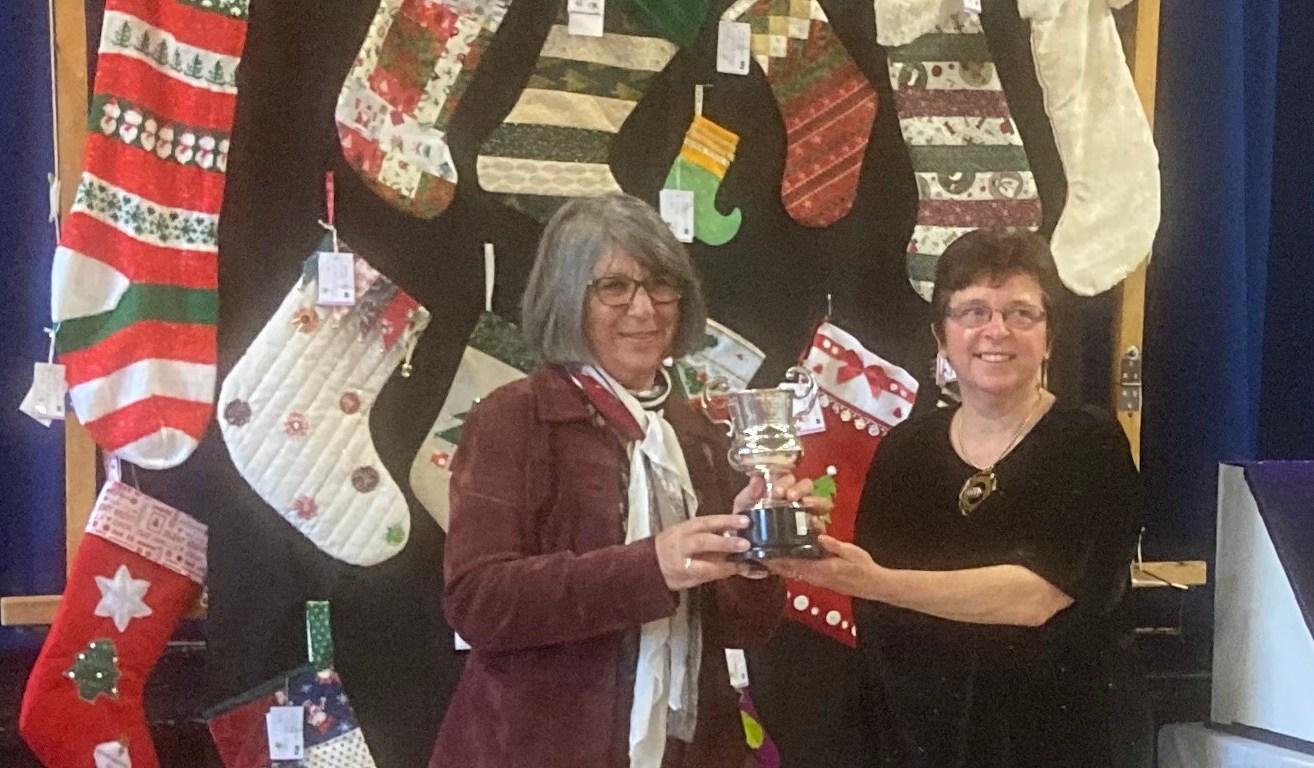
Well done to everyone who has agreed to enter the forthcoming Group Show.
It can seem daunting to enter, but it is important to put it into perspective. The Group Show is an occasion. A chance to show each other what we can do. A chance to work as a team within our WI. It’s not a case of life and death. It’s not about entering the perfect item! Entries are given a score out of 20 and these score are added together for each WI. So the more entires we have, the better chance we have of winning the overall cup! (We came 2nd last year!)
Here is the scoring system:

The founder of the Olympics, Baron Pierre de Coubertin sums it up will when he said, said “The most important thing …. is not winning but taking part; the essential thing in life is not conquering but fighting well.”
Here is some information on how items will be judged from the Handbook ‘On With The Show” which can be found in My WI which is found in the tab “Make, Create & Do’, then under ‘Shows & Competitions’. More details can be found about the judging criteria in ‘On With The Show”.
If you have any questions, please do ask Evelyn.
Entries need to be taken to Evelyn’s on Thursday 23rd March. Or you can take them personally to St Mary Magdalene Church Hall, New Milton between 08.30am and 09.30am on Friday 24th March.
CRAFTS
Each item is marked out of 20, on its own merit, and is not directly compared with other entries.
Recommended Marking Scheme:
Design and use of colour 5 marks
Suitability of materials 3 marks
Techniques and workmanship 9 marks
Finish and presentation 3 marks
Guidelines
These guidelines apply to all crafts and should be used in conjunction with the individual skill notes where listed.
Design and use of colour
A well designed item:
- Is fit for its purpose
- will be suitable for its likely conditions of use and easy to maintain for its expected lifespan
- Is safe and easy to use
- Is pleasing to look at and handle.
Aspects to be considered might be: shape, scale, balance, space, colour, texture, proportion, form, variety, harmony.- If the schedule states ‘credit will be given for original design’ then any craft item not shown to be
from an original design cannot gain the full five marks. - How colour is used within an item is important. Relative colour values will be considered and ooked at objectively. Colour schemes need to be compatible, and whether simple or complex, harmonious or contrasting, they need to have a discernible relationship.
The judge should not be influenced by personal colour preferences.
ART & PHOTOGRAPHY
The judges will be looking at:
- eye appeal (focal point)
- colour
- perspective
- balance and composition
- tonal value
- use of materials (including presentation).
Recommended Marking Scheme for Photography
Each photograph is marked on its own merit, out of 20 marks
Interpretation 7 marks
Does the photograph show originality?
Does it comply with the schedule and the class title?
Technical Quality 5 marks
Is the photograph perfectly in focus?
Is it properly exposed?
Composition 5
Is the photograph well composed with
the emphasis on the main subject?
Presentation 3 marks Is the photograph clean and suitably mounted and/or framed?
COOKERY
Recommended marking scheme (For exhibits including bread, cakes, scones, biscuits and pastries.)
Each item is marked on its own merits, out of 2O marks. The majority of marks are given for
flavour/aroma, because this is the hallmark of home cooking.
External appearance 4 marks
colour, shape , uniformity
Internal condition 4 marks
depth of crust, texture, distribution of ingredients
Flavour/aroma 12 marks
The flavour/aroma should be characteristic for the item judged, e.g., there should be no ‘off ’
flavours or staleness, and no pronounced odours (rancidity, mustiness, yeastiness, etc.). There
should be an average acceptance of spices, flavourings and salt. A judge will observe aroma as
well as taste, and will not be influenced by strong personal preferences in flavours.
Guidelines (flavour marks out of 12)
12 Excellent (100%), a good balance of flavours, true to type
11 Very good, but lacking in one aspect of flavour
10 Good, but lacking in more than one aspect of flavour
8-9 Average, but lacking in several aspects of flavour
6-7 Below average, bland, flavourless, untypical
Below 5 Not acceptable (NA), not edible, uncooked, off flavours. If it is not acceptable, the
exhibit will NOT be marked.
Recipes
If the schedule requested that a recipe is displayed it should be a set of instructions for preparing
a particular dish including:
- List of ingredients
- Method
- Cooking required
PRESERVES
Preservation is a method of ‘keeping’ fruits and vegetables at their best, for use until the next
season of production. Containers are sealed to preserve items for this length of time or longer.
Low sugar jams, fruit curds, mincemeat and uncooked chutneys and relishes are not
accepted as true preserves as they do not have this lengthy keeping ability (see further notes in
this section), but are marked using the same recommended marking scheme.
Recommended marking scheme
For exhibits including jams, jellies, marmalade, bottled fruit, fruit syrups and squash, vinegar
preserves and herbs.
Each item is marked on its own merits, out of 20 marks.
External standard
Container, cover, label, appearance 2
Internal standard
Colour and quantity 5
Quality
Consistency and texture 6
Flavour and aroma 7
General guidelines
Entry should be correct by the schedule (for example, size of jar, contents)
Plain jars must be used for showing preserves.
Jars filled to within 3 mm (⅛ inch) of top. Fill to the top and allow for shrinkage.
Should be in a class of their own.
- Based on fruit and vegetables, but other ingredients (for example, spices etc.) may be added;
label accordingly. - Label should state hot or mild.
- Colour will vary according to type, but bright and characteristic.
- Schedule may state size of jar and type of fruit or vegetables to be used.
- No air bubbles or scum.
- Fruit/vegetables cut evenly.
- Flavour characteristic of ingredients used.
- FRUIT CURD
- This contains eggs and butter and is cooked at a low temperature, therefore it is not a true
preserve. - Fruit curd must be covered with a ‘breathing’ top (that is, a wax circle and cellophane top).
Curd does not achieve high enough temperatures for wax to seal, but disc forms double dust
cover. - Twist tops are not acceptable (NA).
- Colour bright, characteristic and even.
- Consistency spreadable, but not runny or rough.
- No egg spots, peel, scum, sugar crystals or air bubbles.
- Flavour fresh and well balanced, with no greasy taste.
- Must state date when made.
- Should be refrigerated and consumed within 4 weeks
RELISHES
Many recipes are available, but these are not true preserves as they are not fully cooked and will not keep.
- The schedule should clearly identify the type available.
- Be careful when interpreting schedule.
- Attractive and interesting in flavour and texture.
- Treat as salads, refrigerate and use quickly.
- Do not use airtight jars as fermentation may cause explosion. They are usually presented in
a pot. If a jar is requested, make fairly firm, cover with a waxed disc and cellophane and label
short term preserve.
FLORAL DESIGNS
Recommended marking scheme. Each item is marked on its own merits, out of 20 marks.
Interpretation 3 marks
Colour harmony 3 marks
Design: balance, proportion, space, form, texture 6 marks
Suitability of other components 3 marks
(base, accessory/ies, container, background)
Presentation and distinction 2 marks
Flower arranging schedules should not use the word arrangement but state exhibit. An
arrangement is restrictive whereas an exhibit can contain backgrounds, bases, containers,
drapes, exhibit titles, mechanics and more than one placement, all of which must be arranged
within a space allowed stated in the show schedule, unless otherwise stated.
The schedule will specify:
- Remember that:
- A foliage exhibit – leaves and unopened buds of any plant not showing petal colour.
Flowerless bracts are acceptable as foliage. - All components should be neat and clean.
- Accessories – any component that is not natural plant material e.g., candles, shells, stones,
ribbon etc. - All entries should show good overall harmony in the choice of colour, texture and form of
plant material chosen. - There should also be evidence of good design by creative overall balance, scale and
proportion and rhythm with a good overall shape.
 Brockenhurst Women's Institute